Reviewed by GIA graduate gemologists
UnderstandingDiamond Clarity
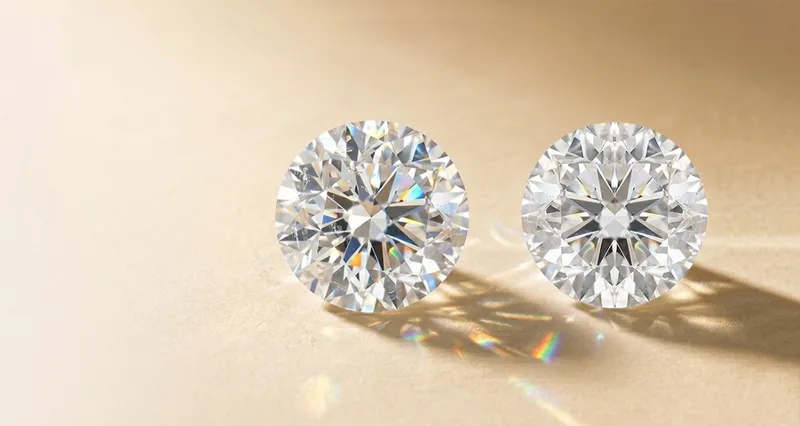
Every diamond, lab-grown or natural, carries tiny internal characteristics from the way it forms. Clarity grading measures how visible those characteristics are - and in most diamonds, they are not visible to the naked eye at all.
Money-back
guarantee
guarantee
GIA certified
diamonds
diamonds
#1 on
Trustpilot
Trustpilot
Free insured
shipping
shipping
Reviewed by GIA graduate gemologists
UnderstandingDiamond Clarity
Every diamond, lab-grown or natural, carries tiny internal characteristics from the way it forms. Clarity grading measures how visible those characteristics are - and in most diamonds, they are not visible to the naked eye at all.
Money-back
guarantee
guarantee
GIA certified
diamonds
diamonds
#1 on
Trustpilot
Trustpilot
Free insured
shipping
shipping
What’s inside this guide
- 01.What is clarity?
- 02.The clarity scale
- 03.Inclusions & blemishes
- 04.Where to save
- 05.FAQs
01.Definition
Every diamond has inclusions - clarity grades them
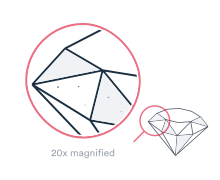
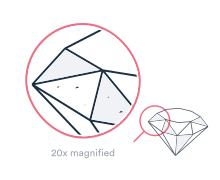
As a diamond crystallizes, it traps tiny internal features called inclusions. This happens whether the diamond is grown in a lab over a few weeks or formed naturally over billions of years - the underlying physics is the same. Some inclusions are mineral crystals, some are gas pockets, some are stress fractures.
A clarity grade tells you how big, how many, where, and how visible those features are. It does not tell you whether you’ll see them in a ring.
The single phrase you need is eye-clean - a stone whose inclusions are noted on the certificate, can be seen by a gemologist under 10× magnification, but are invisible when you look at the ring on a hand.
The clarity scale

02.Scale
The clarity scale, from FL to I3
Clarity is graded on an 11-grade scale, from Flawless (FL) at the top to Included (I3) at the bottom. Here is what each tier means, and when it makes sense to choose it.
FL - Flawless: No inclusions or blemishes under 10× magnification. The rarest grade, and priced to match - usually chosen for collecting rather than for how it looks on the hand.
IF - Internally Flawless: No inclusions inside the diamond; only tiny surface marks a gemologist can find at 10×. Looks identical to Flawless once it is set in a ring.
VVS1 / VVS2 - Very, Very Slightly Included: Inclusions so small they are hard for a gemologist to find even under magnification. A good choice if you want the reassurance of a near-perfect grade.
VS1 / VS2 - Very Slightly Included: Minor inclusions, difficult to see at 10× and almost always invisible to the naked eye. A popular balance of clarity and price.
SI1 / SI2 - Slightly Included: Inclusions are visible under 10× and can sometimes be seen with the naked eye. Many SI1 diamonds are eye-clean; SI2 varies, so review the video. The best place to look for value, as long as you check each stone.
I1 / I2 / I3 - Included: Inclusions are easy to see with the naked eye and can affect durability. Rare Carat does not stock these grades.
Very Slightly Included 2
Great balance of quality and value. Small inclusions are hard to notice without magnification.
SI1
VS2
VS1
VVS2
VVS1
IF
FL
03.Inclusions
Types of diamond flaws
When you’re shopping, two things matter more than the grade letter: location (anything under the table, dead-center, is more visible than anything near the girdle) and size (a single 1mm crystal beats a half-dozen pinpoints).
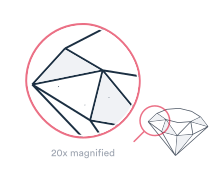
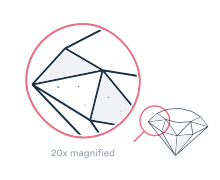
Inclusions sit inside the stone; blemishes sit on the surface. The clarity report (a “plot”) maps them out like a constellation on the diamond outline.
Crystals, pinpoints, clouds, feathers, needles - the common internal characteristics. Tiny ones are invisible to the eye even at SI clarity. A single big crystal under the table can be visible at VS2.
Naturals, polish lines, surface graining - common surface features. Almost never visible without a loupe.
Because location and size matter more than the grade letter, watch the 360° video before you buy. The certificate tells you what’s there; the video tells you whether it matters.
RARE CARAT PRO TIP
For step cuts - emerald, asscher, baguette - bump clarity up to VS2 or better. Their long flat facets work like windows and show inclusions more easily. For brilliants (round, oval, cushion), SI1 with a clean video is the value sweet spot.
Same grade letter, different stories
VVS1
Tiny pinpoints
Tiny pinpoints
VS1
Small crystals
Small crystals
VS2
Off-table features
Off-table features
SI1
Larger but eye-clean
Location and size matter more than count. Always watch the video.
04.Value
Where the smart money goes on clarity
Round, Oval, Cushion, & Pear Cuts: SI1 with a clean 360° video. Eye-clean, with big savings compared to VS.
Emerald, Asscher, & Baguette Cuts: VS2 minimum - their long, open facets make any inclusion easier to spot.
Any diamond over 2 carats: VS2 or better, whatever the shape. A larger stone has a bigger face, so inclusions are easier to notice.
Clarity is the second-easiest C to compromise on after color - the gap between SI1 (eye-clean, ring-ready) and FL (museum piece) is mostly invisible to humans, and very visible on the price tag.
Match clarity to shape
Best value
Round, Oval, Cushion & Pear
SI1 is plenty
Emerald, Asscher & Baguette
VS2 minimum
The right clarity grade depends on the shape. Long, open facets reveal inclusions more easily, so some shapes need a higher grade than others.
05. FAQS
Frequently Asked
Questions
What does “eye-clean” mean?
What’s the best clarity grade for an engagement ring?
Are inclusions bad for a diamond’s durability?
Do lab-grown diamonds have inclusions?
Why do some VS2 diamonds look better than some VS1 diamonds?
Is SI clarity safe to buy?
Keep learning the 4Cs
The remaining three Cs
Each one shapes how a diamond looks, what it costs, and how it pairs with a setting. Read them in any order.
CARAT
Carat weight and size
How carat weight differs from visible size, and the “magic numbers” where price jumps without a visible change.
Read the carat guideCOLOR
The D-to-Z color scale
What each grade on the D-to-Z scale looks like on the hand, and where the savings are invisible to the eye.
Read the color guideCUT
Cut and light performance
Why cut has the largest effect on sparkle, and how the RC Ideal grade rates fancy shapes GIA does not.
Read the cut guideReady to pick a clarity grade?
You've learned what eye-clean really means. Let our AI surface diamonds that look flawless without paying for flawlessness.