Reviewed by GIA graduate gemologists
UnderstandingDiamond Cut
If you prioritize one of the 4Cs, make it cut. Cut determines how a diamond handles light - its brilliance, its fire, and the scintillation you see as the stone moves.
Money-back
guarantee
guarantee
GIA certified
diamonds
diamonds
#1 on
Trustpilot
Trustpilot
Free insured
shipping
shipping
Reviewed by GIA graduate gemologists
UnderstandingDiamond Cut
If you prioritize one of the 4Cs, make it cut. Cut determines how a diamond handles light - its brilliance, its fire, and the scintillation you see as the stone moves.
Money-back
guarantee
guarantee
GIA certified
diamonds
diamonds
#1 on
Trustpilot
Trustpilot
Free insured
shipping
shipping
What’s inside this guide
- 01.Why cut matters most
- 02.Cut grades
- 03.Anatomy of a cut
- 04.Cut vs. shape
- 05.FAQs
01.Why
Cut is the single biggest factor in how beautiful a diamond looks
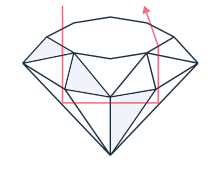
Color, clarity, and carat decide what a diamond is. Cut decides what a diamond does: how much light it captures, how that light bounces back, and whether the stone reads as alive or dead from across a room.
A poorly cut D-Flawless 2-carat will look duller than a well-cut H-VS2 1-carat, and cost a lot more.
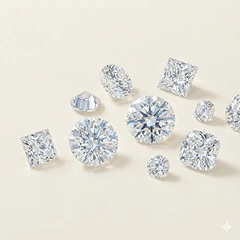
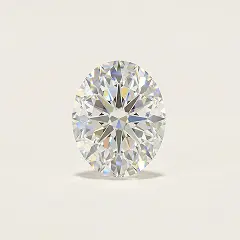
Three things show up in a well-cut diamond: brilliance (white light return), fire (the rainbow flashes), and scintillation (the sparkle as the stone moves).
The light return
RC Ideal
Rare Carat Ideal Cut
A well-cut diamond catches and returns light evenly across its entire surface.
02.Grades
The five cut grades, and where the value is
The GIA grades cut on five tiers: Excellent, Very Good, Good, Fair, and Poor. Rare Carat adds an even higher tier - RC Ideal - for diamonds whose proportions and light performance test exceptionally well.
RC Ideal: the best of the best. Maximum brilliance, fire, and scintillation across the entire stone.
Excellent: indistinguishable from Ideal face-up to most eyes. The most popular option.
Very Good: still beautiful sparkle with minor proportion compromises. You can often get great value here.
Good: noticeably less light return. Fine for accent stones, less ideal for a center stone.
Fair / Poor: we don’t recommend either as a center stone. The light loss is visible.
RC Ideal cut
The best of the best. Maximizes brilliance, fire, and sparkle with perfect proportions.
Good
Very Good
Excellent
RC Ideal cut
03.Anatomy
What cutters are actually adjusting
Cut grading is an evaluation of three properties. First, a quick definition: a facet is one of the small, flat, polished surfaces that cover a diamond - a round brilliant has 58 of them. Cut grading measures how well those facets are shaped and arranged:
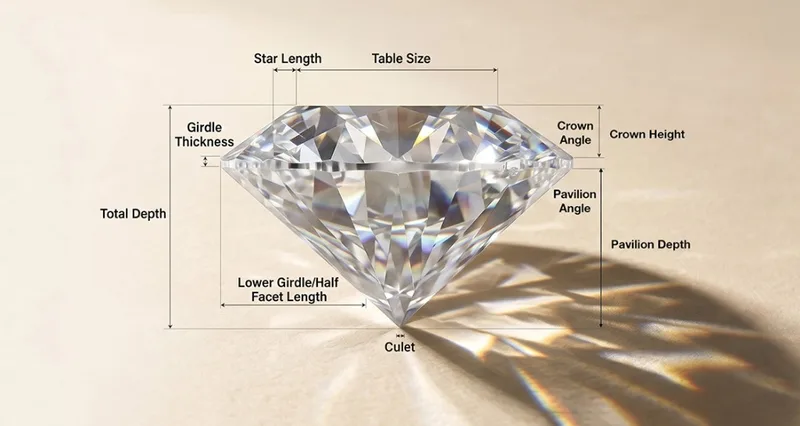
Proportions - the angles and sizes of each facet, especially the table (top), crown (slope from table to girdle), pavilion (slope from girdle to point), and depth (overall height). Get these into a narrow range and light enters and exits the diamond cleanly.
Polish - the surface smoothness of every facet. Poor polish scatters light and dulls the brilliance.
Symmetry - how precisely each facet aligns with its opposite. Poor symmetry steers light at uneven angles, producing dim or dead spots.
A well-cut diamond gets all three right at once. That’s the craft.
RARE CARAT PRO TIP
Fancy shapes (oval, pear, cushion, marquise) don’t receive an official GIA cut grade - only round diamonds do. That’s where our AI comes in: we analyze proportions and light performance for every shape and surface the “RC Ideal” stones automatically.
Three properties at once
- Proportions - table, crown, pavilion angles
- Polish - facet-surface smoothness
- Symmetry - opposing-facet alignment
Focus on all three of these to maximize brilliance.
04.Shape
Cut vs. shape - they’re not the same thing
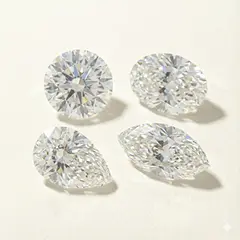
Shape is the outline: round, oval, princess, cushion, emerald, pear, marquise, radiant, asscher, heart.
Cut is how well the diamond was faceted within that outline. A round diamond can be cut Excellent or Poor; so can an oval diamond.
The two interact: brilliant-faceted shapes (round, oval, pear, cushion, radiant) hide inclusions and color better. Step-faceted shapes (emerald, asscher, baguette) are more demanding - they need higher color, higher clarity, and stellar cut.
Don’t confuse a popular shape with a guaranteed cut. Every shape comes in every cut quality - and the gap between a great cut and a mediocre cut, within the same shape, is enormous.
Every shape, every cut
Round
Oval
Princess
Emerald
Pear
Shape is the outline. Cut is the craftsmanship inside it. Both matter - for very different reasons.
05. FAQS
Frequently Asked
Questions
What’s the best diamond cut?
Is cut more important than carat?
What’s the difference between cut and shape?
Why do fancy-shaped diamonds not have an official cut grade?
Will a thicker pavilion make my diamond look bigger?
How does cut affect price?
Keep learning the 4Cs
The remaining three Cs
Each one shapes how a diamond looks, what it costs, and how it pairs with a setting. Read them in any order.
CARAT
Carat weight and size
How carat weight differs from visible size, and the “magic numbers” where price jumps without a visible change.
Read the carat guideCOLOR
The D-to-Z color scale
What each grade on the D-to-Z scale looks like on the hand, and where the savings are invisible to the eye.
Read the color guideCLARITY
Clarity and inclusions
Inclusions, the clarity scale, and how to choose a diamond that is eye-clean without overpaying.
Read the clarity guideReady to find a stone that sparkles?
You've learned why cut matters most. Let our AI surface diamonds graded RC Ideal - the best of the best across every shape.