Best Place to Buy GIA Certified Diamond Engagement Rings
Discover why thousands of buyers choose Rare Carat for certified engagement rings
- Rare Carat offers GIA, IGI, and GCAL-certified diamonds with two-step verification for authenticity.
- Compare natural and lab diamonds using advanced filters designed after the 4Cs.
- Expert guidance with HD imagery, 360° videos, and free gemologist guidance.
- Choose from 1,700+ setting styles including solitaire, pavé, three-stone, and hidden halo designs.
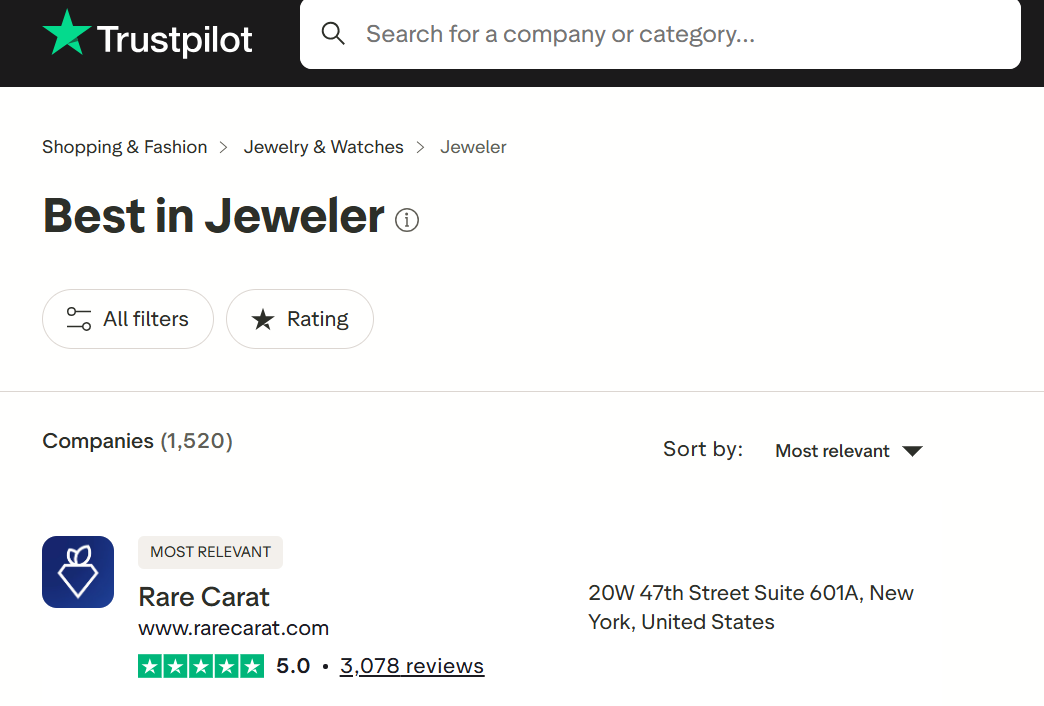
- Shop with confidence: free shipping, 30-day returns, lifetime warranty, and 5-star Trustpilot rating.
A lot of engagement ring shoppers don't start out searching for GIA certified diamonds.
At first, they're usually focused on things that feel easier to picture: the ring style, the diamond shape, and the size (carat weight) that will help to stay within budget. Certification tends to enter the conversation later.
Often it happens after comparing a few diamonds online and realizing they all look surprisingly similar.
That's when buyers start asking different questions. Why is one diamond priced higher than another? Is the color grade actually better? Does the clarity difference matter? Can you trust what you're seeing on a product page?
For many people, a GIA report becomes a way to bring a little more clarity to a purchase that can otherwise feel difficult to evaluate from a screen.
Still, finding the best place to buy GIA certified diamond engagement rings involves more than simply choosing a retailer that offers certified diamonds.
The bigger question is what happens after the certificate is attached to the diamond. Can you easily compare similar options? Is there someone available to explain the tradeoffs between two stones that look nearly identical on paper? Does the retailer help narrow the choices, or are you left sorting through hundreds of possibilities on your own?
Those questions often end up mattering just as much as the certification itself.
And for buyers who are still comparing retailers more broadly, it can be useful to start with a guide covering where to buy diamond engagement rings online, then narrow the search based on priorities like certification, customization, diamond selection, and overall buying experience.
In the sections below, we'll look at why GIA certification matters, what shoppers frequently overlook when comparing certified diamonds, and which factors are worth paying attention to when choosing an engagement ring retailer.
1. Why Certification Matters More When Diamonds Look Nearly Identical
When shoppers reach the point of comparing actual diamonds for engagement ring designs, something interesting usually happens.
At first glance, many options look almost the same.
Two stones can share the same carat weight, similar shape, and even a close color grade, yet still sit at noticeably different price points. That’s usually where certification starts to matter in a practical way rather than a theoretical one.
It becomes less about “this diamond is certified” and more about how to interpret what the certification is actually telling you.
A GIA report, for example, doesn’t just confirm that a diamond has been evaluated. It standardizes how that diamond is understood across the entire market. The same applies to IGI and GCAL grading systems, which help bring consistency to characteristics that would otherwise be difficult to compare side by side.
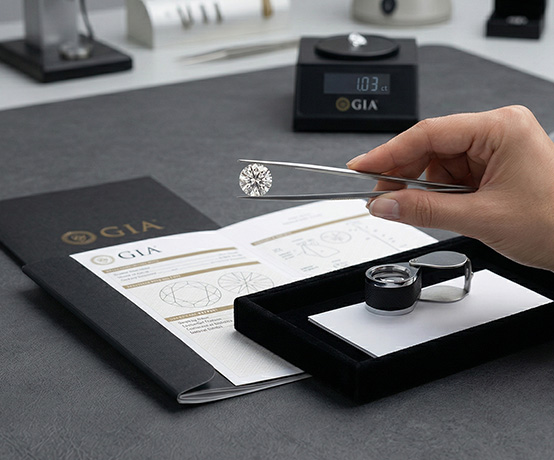
In practice, this is also why some buyers prefer starting with diamonds that are already fully standardized under these grading systems, rather than trying to interpret mixed or unclear certification formats.
At Rare Carat, for example, every diamond listed is certified by GIA, IGI, or GCAL. A free diamond report and certification check option is also provided, so buyers are not left decoding technical grading language on their own.
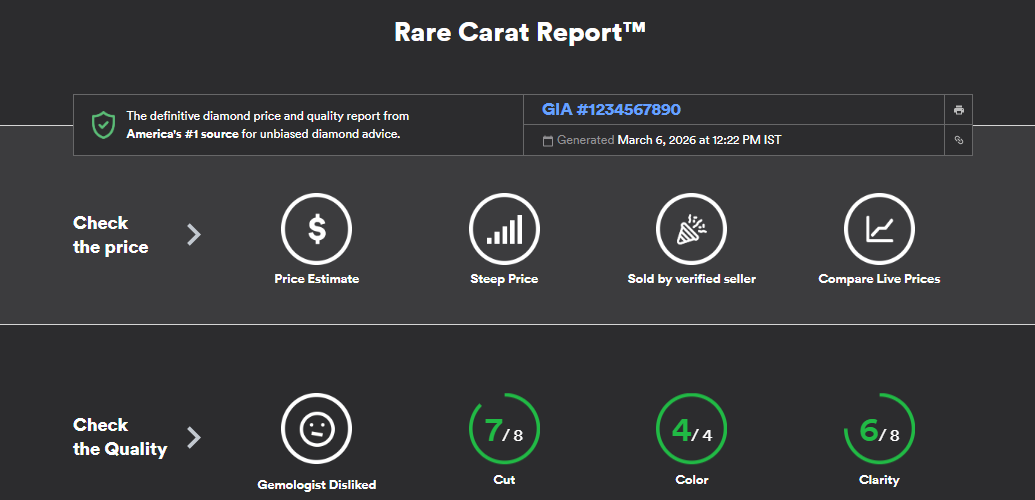
When diamonds look similar online, small grading differences start to carry more weight than expected, especially in areas like cut precision, clarity visibility, or color warmth.
Where certification actually changes the decision
Instead of treating certification as background documentation, most buyers eventually start using it as a comparison tool.
Here’s what tends to matter most in real shopping decisions:
| What Buyers Are Comparing | Why Certification Matters Here |
|---|---|
| Two diamonds with similar specs | Certification helps confirm whether differences are real or just listing variation |
| Price differences with similar appearance | Grading consistency explains why two visually similar stones may not be priced the same |
| Cut and light performance | Certified grading provides a structured way to evaluate sparkle potential |
| Clarity under real viewing conditions | Reports help interpret whether inclusions are likely to be visible to the eye |
At this point, certification stops being paperwork and starts becoming a way to reduce guesswork.
But there’s an important detail many buyers only realize later. Not every retailer treats certification the same way after the diamond is sourced. Some simply list the grading report. Others build additional checks around it before the diamond ever reaches the customer.
That difference becomes more relevant as the buying process moves forward.
2. What Actually Happens After a Diamond Is Certified
Once a diamond has a GIA, IGI, or GCAL report attached, it’s easy to assume the hard part of the process is over.
For many buyers, that certificate feels like the final checkpoint. In reality, it’s closer to the moment where evaluation becomes standardized, not the moment where the buying experience is finished.
Because certification tells you how a diamond has been graded—but it doesn’t fully explain how that diamond is handled, verified, or prepared before it reaches the customer.
And that gap is where retailer processes start to matter more practically.
Some retailers rely strictly on the grading report as the main source of truth. Others introduce additional layers of handling once the diamond is sourced, especially before it is listed, set, or shipped.
That difference is not always obvious from a product page, but it becomes more relevant as buyers move closer to making a decision.
Where the post-certification process starts to diverge
At a high level, most diamonds follow a similar path after grading. The differences appear in how carefully each step is controlled and verified.
| Stage After Certification | What It Means for Buyers |
|---|---|
| Diamond enters retailer inventory | Handling standards and internal checks can influence consistency before listing |
| Certificate is linked to the stone | Most buyers assume this is sufficient, but verification depth varies by retailer |
| Diamond is prepared for listing or setting | Some retailers add inspection steps, others move directly to availability |
| Final quality confirmation before shipping | This is where differences in trust and transparency become most noticeable |
At this stage, certification is still essential, but it is no longer the only layer influencing confidence.
What buyers often start looking for is something beyond grading itself—reassurance that the diamond they receive matches both the report and the expectations formed during online viewing.
That’s where additional verification processes become more relevant, especially for shoppers comparing retailers more closely.
The gap buyers don’t always see
From a buyer’s perspective, two diamonds with identical certifications can feel interchangeable on paper.
But the experience behind those diamonds can differ depending on how carefully they are checked after sourcing.
This is where some retailers start adding more structured checks before a diamond is delivered, mainly to confirm that what’s on the certificate actually matches the stone being shipped.
At Rare Carat, for example, every certified diamond goes through a two-step verification process once it arrives at the facility. It’s meant to add another layer of certainty on top of the grading report, not replace it.
The first check is an inscription match. The microscopic laser inscription on the diamond’s girdle is located under high magnification (around 60x–110x) and cross-verified against the certificate number. It’s a simple but important way to confirm the identity of the stone.
After that, the diamond is checked using professional UV fluorescence equipment to confirm its characteristics and authenticity. And if something needs a closer look, certain stones go through additional Yehuda machine testing or authorized lab-level checks before they move forward.
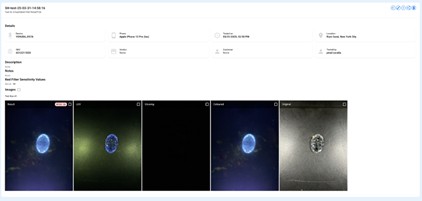
All of this is done under controlled conditions, with documentation captured as part of the internal process, so there’s a clear record before the diamond progresses toward final preparation or shipping.
At that point, the conversation naturally shifts. It’s no longer just about whether a diamond is certified on paper—it becomes about how that certification is actually verified once the stone is in a retailer’s hands.
3. How Buyers Actually Compare Certified Diamonds Without Getting Overwhelmed
Once certification and verification feel clear, the real friction usually starts somewhere else entirely.
It’s not doubt anymore—it’s volume.
There are simply too many diamonds that look “correct” on paper.
Same grading systems. Similar carat range. Close color and clarity. Even comparable pricing bands.
And yet, the experience of choosing between them doesn’t feel straightforward.
When “certified” stops being the hard part
Most buyers don’t struggle because they doubt certification at this stage.
They struggle because everything looks technically valid.
That leads to a familiar pattern:
- Multiple diamonds appear equally “good” in listings.
- Small differences in cut, fluorescence, or clarity feel hard to interpret.
- Price differences don’t always feel logically connected to appearance.
- It becomes unclear which tradeoff actually matters.
At this point, certification has done its job. The challenge has simply moved to comparison.
What actually starts influencing the decision
When shoppers begin narrowing options, the focus quietly shifts away from certification itself and toward how readable the differences are.
A few things tend to matter more than buyers initially expect:
- Whether diamonds are presented in a way that makes comparison easy
- Whether tradeoffs are explained in plain language instead of technical grading terms
- Whether visual tools (like images and 360° views) reduce guesswork or add confusion
- Whether filtering actually narrows meaningful differences, not just price
This is where many buyers either gain confidence quickly—or slow down significantly.
Because the issue is no longer access to information.
It’s clarity.
The role of presentation (this is where decisions quietly change)
Two diamonds can be nearly identical on paper, but feel very different depending on how they’re shown. Not because the stone changes, but because understanding changes.
Shoppers tend to notice this when:
- One listing shows multiple high-quality angles while another feels limited
- One comparison highlights tradeoffs clearly, while another leaves interpretation open
- One interface allows narrowing based on priorities, while another requires manual filtering
This is often where buyers start realizing that the shopping experience itself becomes part of the decision.
Not just the diamond.
Why this matters more for engagement ring buyers specifically
Engagement ring purchases aren’t typically one-variable decisions.
Most buyers are balancing:
- Budget constraints
- Visual size expectations
- Shape preferences
- Setting styles
- Long-term wear considerations
So even small uncertainty in comparison can multiply quickly.
That’s why the comparison stage often becomes the most mentally demanding part of the process—not certification, not verification, but decision compression.
A quieter shift in how confident decisions get made
At this stage, buyers usually don’t need more information.
They need fewer competing interpretations of the same information.
And that’s where the experience of shopping starts to matter just as much as the diamonds themselves.
Some buyers prefer full independence and manual filtering. Others naturally gravitate toward more guided selection where tradeoffs are surfaced more clearly.
That difference in experience is often what determines how quickly someone moves from browsing to actually choosing.
At Rare Carat, this balance is intentionally built into the way diamonds are presented.
Buyers can look at natural and lab-grown diamonds from the very beginning, choosing whatever feels right for them—whether that’s staying within a certain budget, getting a larger-looking stone, or thinking more about long-term value and personal preference. The idea isn’t to push one direction, but to keep both paths equally visible and easy to evaluate.
To support that comparison process, Rare Carat also features over one million diamonds, each shown with high-definition images and 360° videos captured using professional-grade tools used across the global jewelry industry.
These visuals are not edited or retouched. They’re designed to show how a diamond actually behaves—how it reflects light, how clarity characteristics appear in real viewing conditions, and what subtle differences look like when the stone is rotated and observed from multiple angles.
Because sourcing a diamond online is rarely about data alone. It’s about seeing enough detail to feel confident in what the numbers are describing.
And when interpretation still feels difficult, there’s additional support built into the process.
A team of over 100 GIA-certified gemologists is available to guide buyers through comparisons and selection questions at no additional cost. Their role isn’t to replace the buyer’s decision, but to remove uncertainty where technical differences start to feel overwhelming.
That combination—transparent visuals, both natural and lab-grown options, and expert human guidance when needed—is what helps bring clarity back into a process that can otherwise feel crowded with similar-looking choices.
And, once buyers feel comfortable evaluating certified diamonds, the next decision becomes how those diamonds are actually worn.
4. What GIA Certified Diamond Engagement Rings Actually Look Like in Real Choices
Once buyers move past certification and comparison logic, something subtle changes in how they shop.
The focus shifts from understanding diamonds to visualizing a ring they would actually wear every day.
At this stage, most decisions are no longer driven by grading reports or technical differences. They’re driven by design, presence, and how the ring feels in real life.
And that’s usually when browsing becomes more visual than analytical.
From specifications to real design choices
Instead of comparing individual grading details, buyers naturally begin to look at:
- How the diamond sits in different ring settings
- How the overall design changes the perceived size of the stone
- Whether the style feels minimal, detailed, modern, or classic
- How much presence does the ring have once it’s actually on the hand
This is where engagement ring shopping becomes less about numbers—and more about interpretation through design.
Even a 1-carat diamond can feel very different depending on how it is set.
How the same diamond changes across different ring styles
To make that easier to understand, here are some of the most commonly compared engagement ring styles featuring 1-carat GIA-certified diamonds:
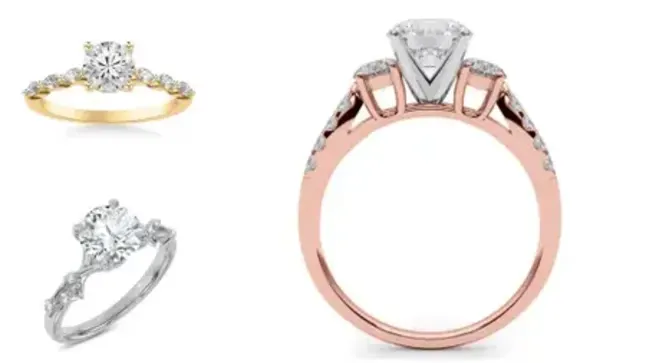
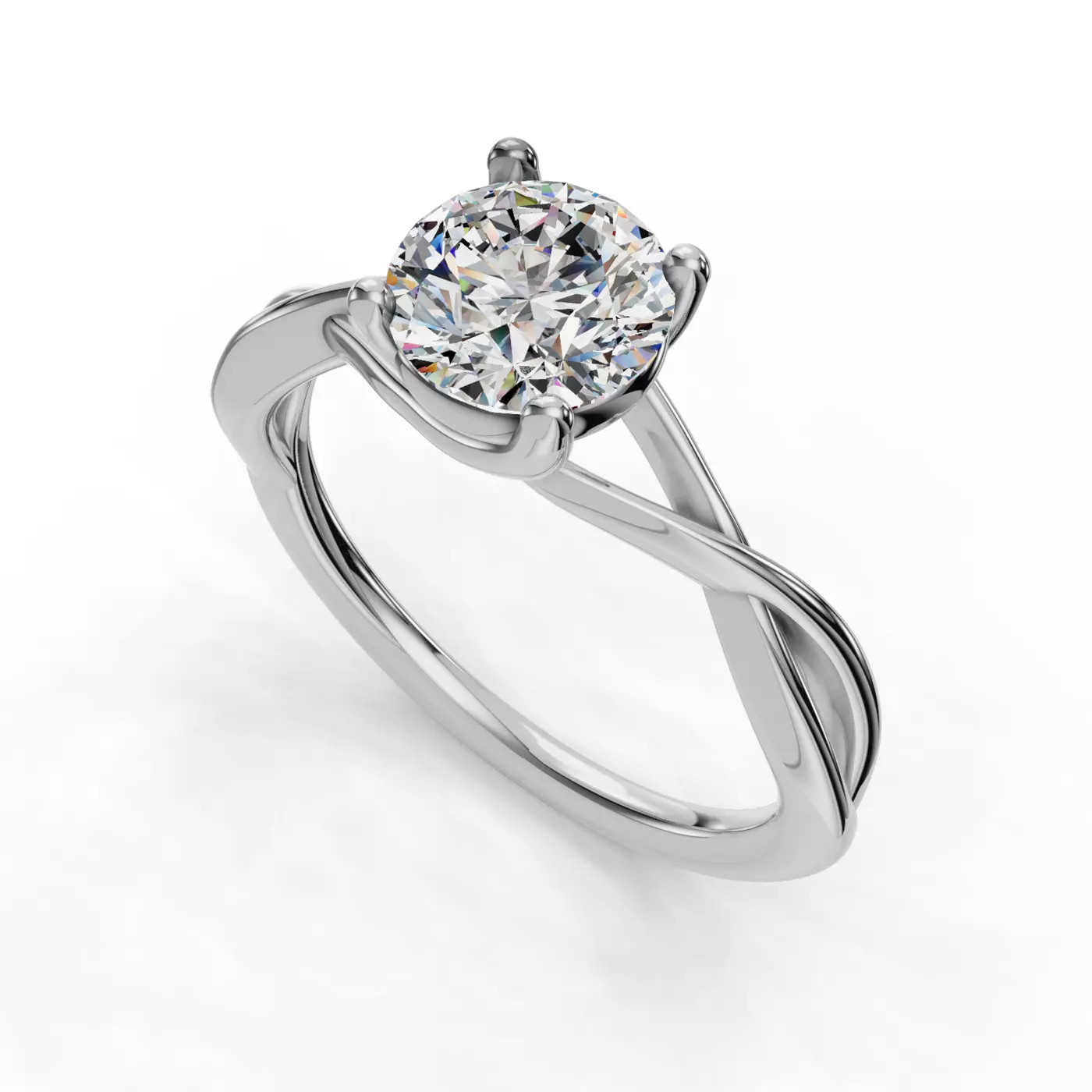
- A Twisted Solitaire Ring With Subtle Movement
At first glance, this looks like a classic solitaire. Then the twist in the band starts to stand out.
The twist becomes more noticeable as your eye moves toward the center diamond, giving the ring a softer, more organic look than a traditional straight-band solitaire.
The gallery basket helps keep the center stone open and visible from different angles, and since the setting works with any diamond shape, buyers have plenty of freedom to create a look that feels personal to them.
- A Nature-Inspired Pavé Ring With Delicate Detail
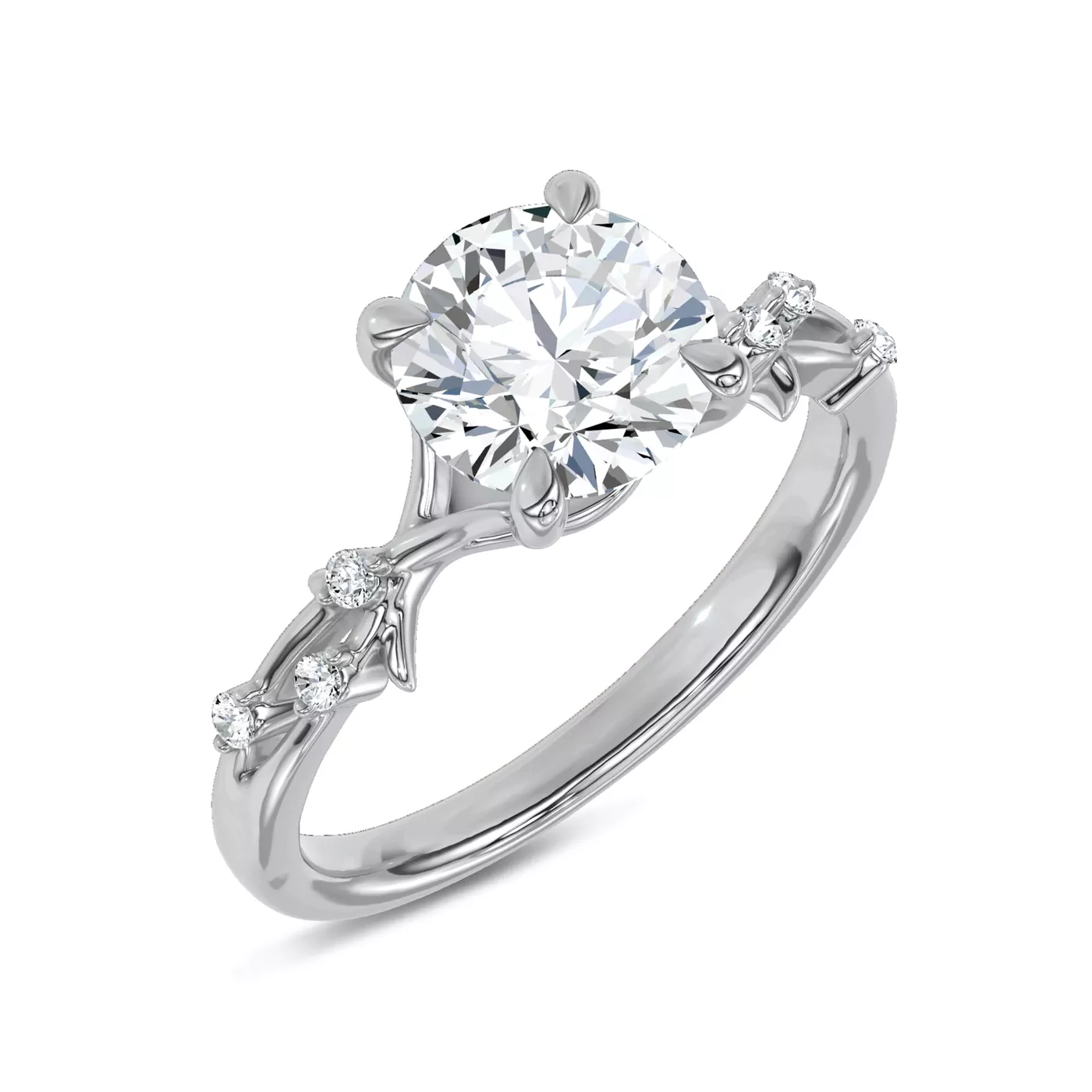
Not every pavé ring follows a straight, structured design.
What makes this ring feel different is the movement in the design. Instead of taking a typical plain band, the band curves gently as it moves upward, giving the ring a softer look overall.
Small accent diamonds are worked into those details, adding a little extra sparkle along the way without making the design feel too elaborate. However, the center diamond still does most of the talking.
Another nice detail is how flexible the setting is—it can take on a very different personality depending on the shape you choose.
- A Hidden Halo Ring With Unexpected Detail
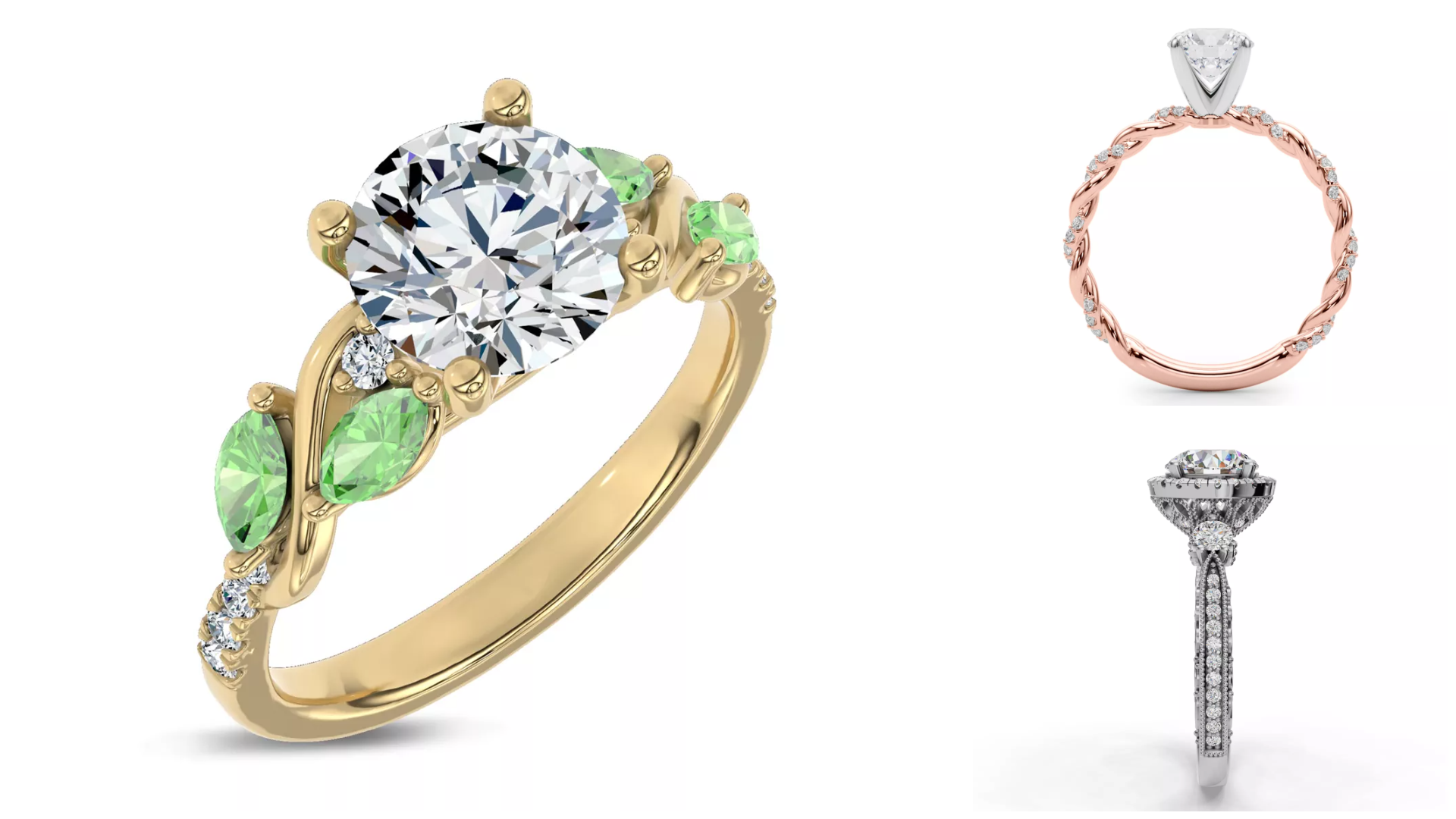
At first, your attention goes straight to the center diamond. Then the marquise accents along the band start to reveal themselves.
The marquise accents bring a different kind of detail to the band. Instead of a continuous row of smaller diamonds, they add a bit more shape and character around the center stone. Beneath it, the hidden halo sits just out of sight, revealing flashes of extra sparkle from the side rather than competing with the main diamond from the top view.
Even with those added details, the center stone remains the part your eye keeps coming back to.

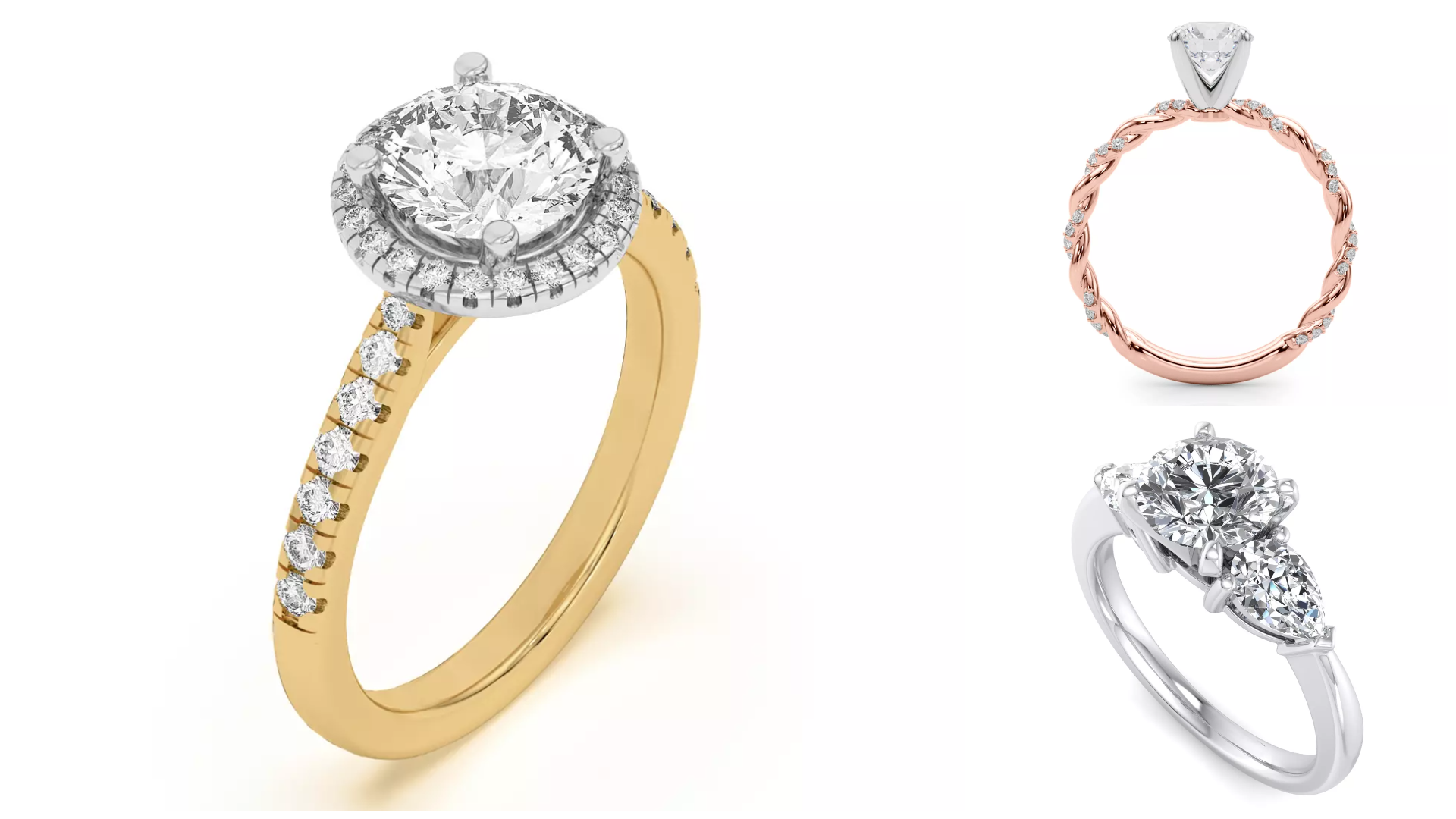
- A Four-Prong Setting With Contrast Accents
Not every ring gets its character from the center diamond alone.
Here, some of the visual interest comes from the accents surrounding it. Depending on the version you choose, those details can blend in quietly with white diamonds or create a much stronger contrast with black diamonds mixed into the design.
It changes the personality of the ring more than you might expect, while the four-prong setting keeps the center stone feeling open and easy to notice from the moment you look at it.

- A Three-Stone Ring With Added Dimension
From the top, the center diamond gets most of the attention. Then the split band starts to come into view. Here, the side stones are secured and stylized with a U-prong design for a unique look.
Instead of approaching the center stone as a single band, the ring opens up slightly as it gets closer, creating more shape and detail around the focal point. There are also subtle pavé details woven into the band, so little bits of sparkle appear as the ring catches the light from different angles.
What stands out most is that none of those details feel like too much.

Natural vs Lab-Grown: Same Design, Different Priorities
While all the styles above can be created using either natural or lab-grown diamonds, the decision between the two often comes down to how buyers balance value, size, and long-term preference.
| What Buyers Compare | 1 Carat Lab-Grown Diamond Ring | 1 Carat Natural Diamond Ring |
|---|---|---|
| Typical Price (Same 4Cs) | Often around $1,200–$4,500+ depending on cut, color, clarity, and setting choice | Often around $4,500–$12,000+ for comparable GIA-certified specifications and setting style |
| Visual Appearance | Visually identical to a natural diamond with the same cut, color, clarity, and carat weight | Visually identical to a lab-grown diamond when matched on the same 4Cs |
| Budget Flexibility | Leaves more room to upgrade the setting, increase carat weight, or choose higher specifications | Requires more tradeoffs between size, quality, and setting within the same budget |
| Buyer Priority | Often chosen for maximizing size, sparkle, and overall value | Often chosen for rarity, tradition, and natural origin |
| Shopping Approach | More flexibility to explore different shapes, settings, and quality combinations | More focused on balancing the 4Cs carefully within a set budget |
| Design Freedom | Makes it easier to experiment with more elaborate or diamond-intensive setting styles | Buyers may prioritize the center stone first before allocating budget toward setting upgrades |
5. Why Many Buyers Ultimately Choose Rare Carat
By the time most shoppers reach this stage, they usually aren't looking for more diamond education.
They're looking for confidence.
The certification has been reviewed. The ring styles have been compared. The budget range is becoming clearer.
What often determines the final decision is whether the retailer makes the entire process feel transparent, supported, and easy to navigate from beginning to end.
At Rare Carat, that experience is built around helping buyers move from comparison to confidence without feeling pressured along the way.
| What Buyers Look For | How Rare Carat Helps |
|---|---|
| Independent buyer confidence | Top-rated jeweler on Trustpilot with thousands of verified customer reviews and a 5/5 rating |
| Quality craftsmanship | Engagement rings are handcrafted in advanced jewelry workshops using carefully selected materials and settings |
| Protection after purchase | Free 30-day returns, complimentary resizing options, lifetime warranty coverage, and insured shipping |
| Diamond authenticity | Certification-backed diamonds supported by additional verification and inspection processes |
| Long-term peace of mind | Dedicated customer support and expert guidance available throughout the shopping journey |
No matter where someone ultimately purchases an engagement ring, the most important goal is finding a diamond and setting that feel right for their priorities, budget, and long-term expectations.
Certification helps establish trust in the diamond itself. A strong shopping experience helps establish trust in the decision.
For many buyers, having both in the same place is what makes the process feel significantly easier.
Not sure where to start?
Rare Carat's Quiz helps identify your priorities around budget, diamond size, shape preferences, setting style, and whether a natural or lab-grown diamond may fit your goals best. It's a simple way to narrow the search before comparing individual diamonds and engagement rings.