Best Places to Buy Gemstones Online in 2026
An in-depth guide to choosing a natural gemstone, reading the treatment disclosure and the right certificate
- Natural gemstones across 17 types and 14 colors, filterable by type, color, shape, clarity and price
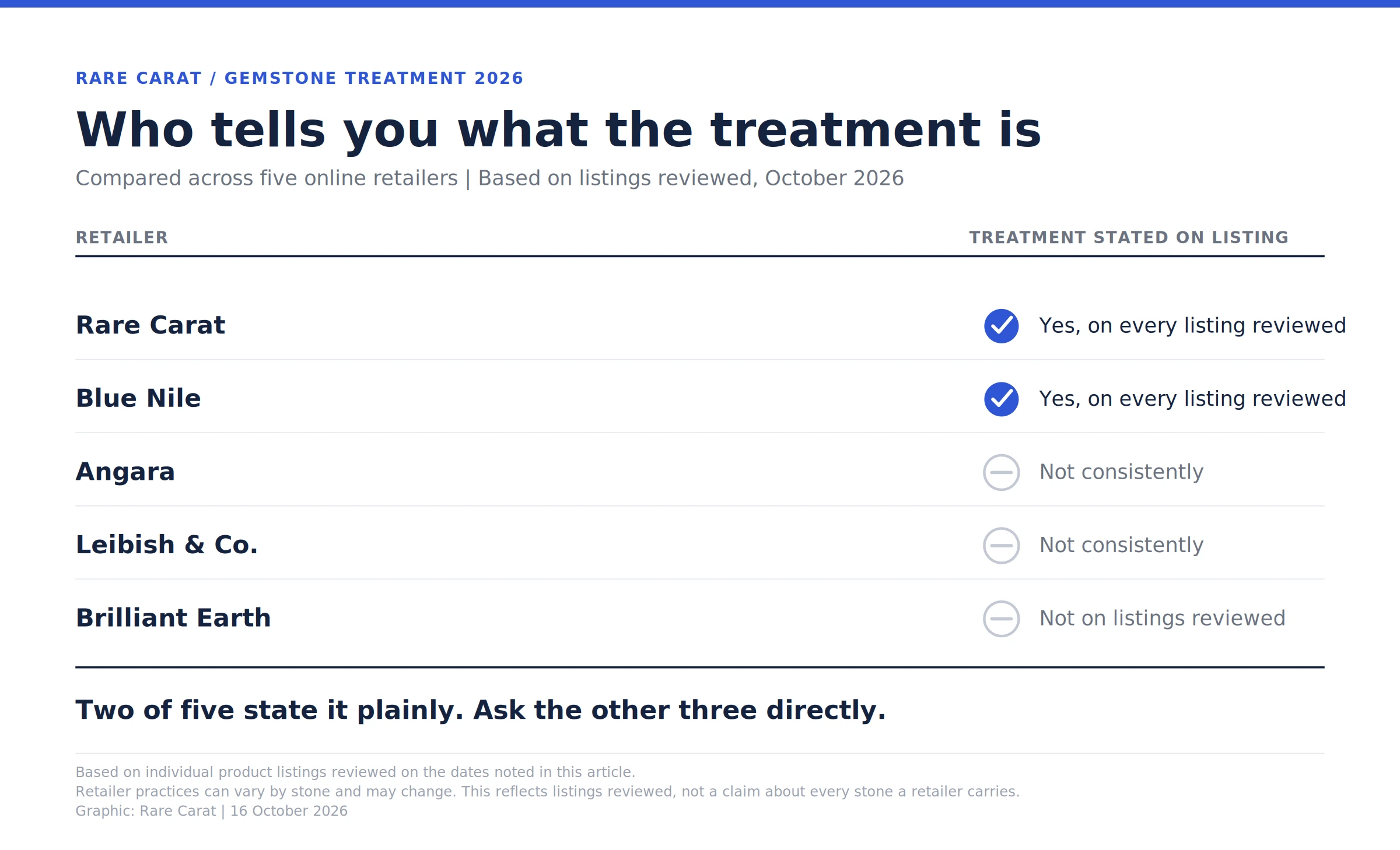
- Treatment disclosed on every product, since heat and other treatments are the central trust question in colored stones
- GSI, GIA and IGI certificate options, plus a no-certificate filter for full transparency on what is and isn’t graded
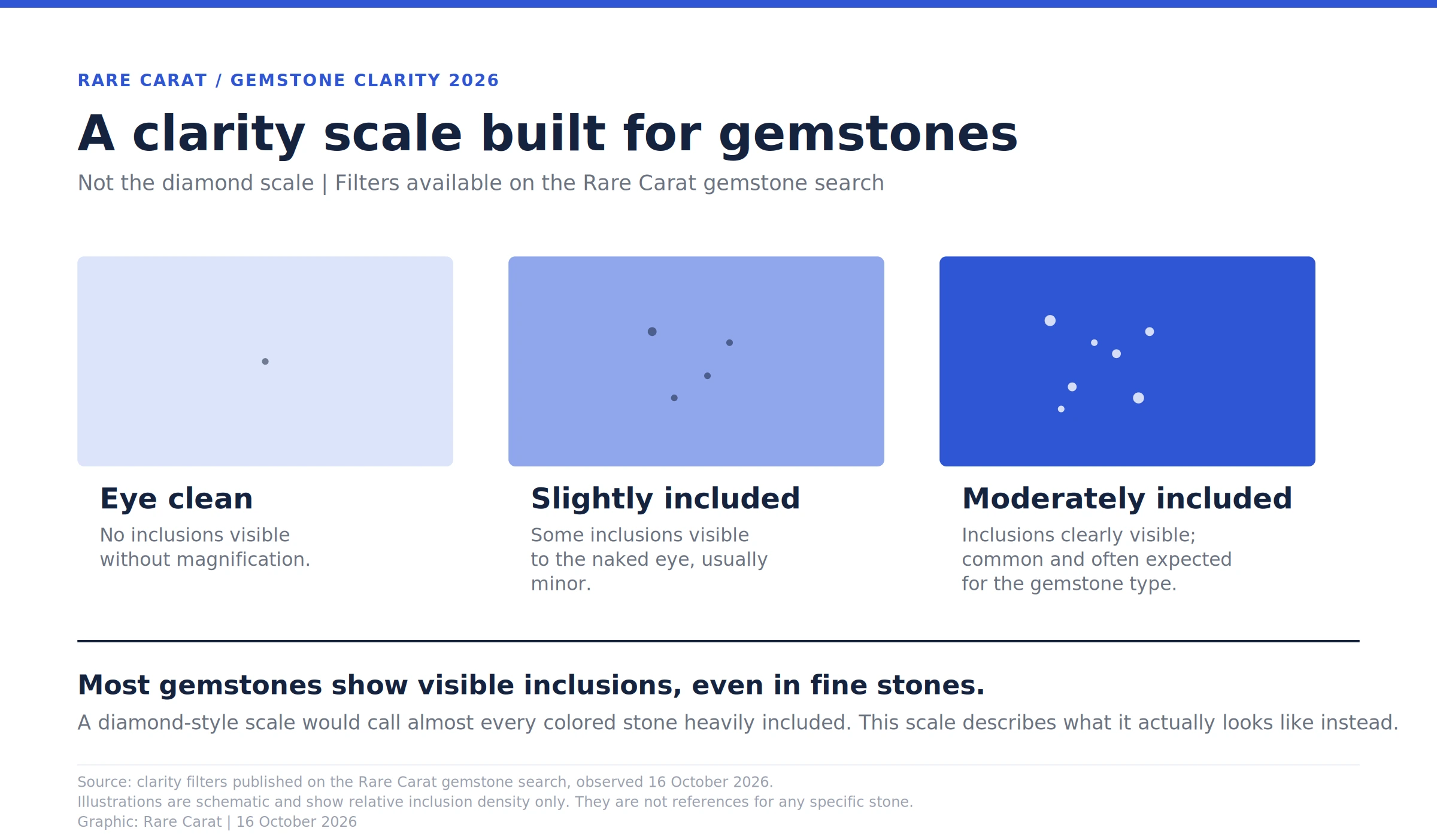
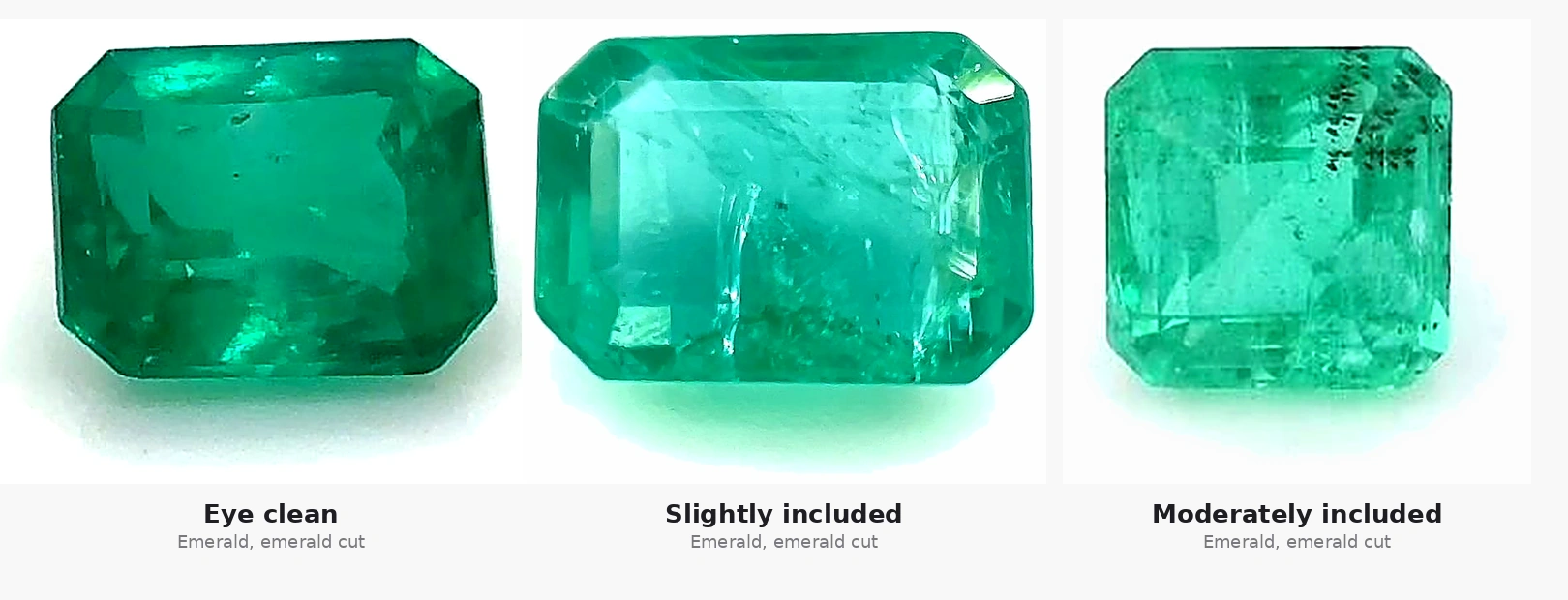
- A clarity scale built for gemstones, not diamonds: Eye clean, Slightly included, Moderately included
- A 5.0 rating on both Trustpilot and Google, across more than 9,000 combined reviews
Best Places to Buy Gemstones Online: Side-by-Side Comparison
Our pick: Rare Carat takes the top spot for buying gemstones online in 2026. On 16 October 2026 its search listed 3,508 natural gemstones across 17 types and 14 colors, filterable by type, color, shape, clarity and price, with certification exposed as a filter so a shopper can restrict results to GSI, GIA or IGI before browsing further. The individual product page discloses treatment directly as its own field, stating plainly whether a stone has been heated or otherwise enhanced, or stating “no treatment reported” when it hasn’t, alongside its clarity to the eye, its gemstone type and a link to verify the certificate itself.
A 30-day money-back window and free insured shipping sit behind the purchase. For a finished piece rather than a loose stone, the gemstone jewelry collection covers rings, bracelets and necklaces in sapphire, ruby and more. On catalog breadth, treatment transparency and certificate selection together, no other retailer on this list matches it.
We compared Rare Carat, Angara, Leibish & Co., Brilliant Earth, Blue Nile, James Allen and independent local jewelers on catalog depth, certification, treatment disclosure, returns and pre-shipment verification, to find the best place to buy gemstones online in 2026.
| Retailer | Catalog | Certification | Treatment disclosure | Return window | Price transparency | Pre-shipment verification |
|---|---|---|---|---|---|---|
| Rare Carat Best overall for gemstones | 3,508 natural gemstones across 17 types and 14 colors, listed on 16 October 2026; 0.1 to 30 carats; filterable by shape and clarity, with a price ceiling that varies by gemstone type | GSI, GIA or IGI, selectable as a filter before results load, plus a no-certificate filter for full transparency | Stated as its own field on every product checked, in both directions ("Heated" or "No treatment reported"), alongside clarity to the eye and gemstone type | 30 days, money-back, no restocking fee | Full pricing online with video; certificate verifiable via a direct link on the product page | Free 30-day returns and lifetime guarantee stated on every product; authenticity inspection referenced in company policy |
| Angara | Large gemstone and semi-precious stone catalog; built on direct sourcing from mines and manufacturers | GIA-certified gemstones filterable; the company states some pieces carry its own appraisal rather than third-party grading | Not consistently stated on listings reviewed | 30 days | Customization available on cut, metal and carat; pricing positioned as 30-40% below competitors, a claim not independently verified | Not published |
| Leibish & Co. | Natural gemstones alongside its fancy color diamond specialty, including sapphire, emerald and ruby | GIA, Argyle or IGI; the company states some stones carry in-house grading reports | Not consistently stated on listings reviewed | 30 days, no questions asked | Prices listed per stone online; jewelry settings generally priced on request | Not published |
| Brilliant Earth | Gemstone rings built via a setting-and-stone builder rather than a loose-stone catalog; sapphire, emerald, ruby, aquamarine, morganite, alexandrite and more | Not stated as a dedicated gemstone certification; diamond-side certification covers GIA, IGI, HRD and GCAL | Not stated on gemstone ring listings reviewed | 30 days, free return shipping both ways | Full pricing online | Not published for gemstones |
| Blue Nile | Loose natural gemstones, mostly sapphire, sold individually with measurements; also carries James Allen's legacy gemstone ring styles | Not stated as third-party certified on listings reviewed | Stated on every listing (for example "Heated") | Free returns, policy not time-boxed on listings reviewed | Full pricing online; 360° photography at up to 40x magnification | In-house gemologist inspection prior to shipment, per company statement |
| Local jewelers | Varies; usually a small case or a stone sourced on request | Varies; ask for the report before any deposit | Varies; ask directly | Varies; often exchange or store credit | Often no online pricing; negotiable | Often yes, in person |
| James Allen (Out of business) | Gemstone ring styles went out of business in 2026; the designs now sit inside Blue Nile's own gemstone ring catalog | Not published | Not published | Not applicable; any outstanding orders are being honored by Blue Nile going forward | Not applicable | Not published |
Swipe sideways to see all columns. Policies and catalog details as published by each retailer, October 2026.
Where the others fall short: Angara’s catalog depth is real, but treatment is not consistently stated on the listings reviewed, and some pieces carry an in-house appraisal rather than independent certification. Leibish & Co. sells gemstones as a secondary line alongside its colored diamond specialty, and some stones carry in-house reports rather than GIA. Brilliant Earth builds gemstone rings through its setting tool rather than offering a loose-stone catalog to browse and compare, and treatment is not stated on the listings reviewed. Blue Nile does disclose treatment on every stone, which is a genuine strength, but its listings reviewed show no third-party certificate. Local jewelers vary shop to shop, with terms and disclosure depending entirely on who you ask. James Allen’s gemstone ring styles are out of business as of 2026, and the designs now live inside Blue Nile’s own catalog.
Treatment is the question that actually matters
With colorless diamonds, the buyer’s main worry is usually whether the stone is natural or lab-grown, and that distinction is stated plainly on every report. With colored gemstones, almost every stone on the market has been treated in some way, and the real question is which treatment, and whether anyone told you.
Heat treatment is the most common. It is widely accepted across the trade, it is stable, and it is standard on the large majority of commercial sapphire, ruby and many other colored stones. Other treatments exist too: fracture filling in emerald and ruby, diffusion treatments that add color only near the surface, and irradiation used on topaz and some quartz varieties. None of these treatments is automatically a problem. What is a problem is when a product page does not say which one was used, because that is the detail that affects both the stone’s durability and its price relative to an untreated stone of the same type.
Gemstone type matters here too. A topaz is routinely treated to reach its blue color, and that is normal and expected for the category. A sapphire that has only been heated is the market standard and priced accordingly; an unheated sapphire of comparable quality carries a real premium because it is rarer. Neither is the “better” choice in the abstract, but the price only makes sense once you know which one you are looking at.
So the question to ask on any colored stone, before carat or color, is simple: what treatment does this stone have, and does the product page say so, or do you have to ask?
What the gemstone search actually holds
Seventeen gemstone types sit across the top of the search: sapphire, ruby, emerald, amethyst, garnet, topaz, moonstone, citrine, tourmaline, aquamarine, alexandrite, tanzanite, spinel, morganite, apatite, heliodor and an “others” category, which is where less common stones such as zircon show up in results. Colored diamonds sit in that same row of tiles, between emerald and amethyst, but they are a separate product rather than a gemstone type; a fancy color diamond is still a diamond. Fourteen colors filter alongside them: pink, blue, yellow, red, teal, green, violet, purple, black, white, orange, brown, gray and multicolor.

Clarity works differently here than it does for diamonds
Diamond clarity runs a ten-step scale from Flawless down to I3, built around a loupe at 10x magnification. Gemstone clarity on this search uses three plain-language grades instead: Eye clean, Slightly included and Moderately included. That is not a simplification for its own sake; most colored stones carry visible inclusions even in fine examples, and a scale built for diamonds would call almost every gemstone on the market heavily included, which would be misleading rather than precise. Eye clean means what it says: no inclusions visible without magnification.
Shapes and the practical range
Ten shapes are available: round, oval, cushion, emerald, princess, radiant, pear, marquise, asscher and heart. Carat runs from 0.34 to 24 across the board. The price slider’s ceiling moves with the type selected; browsing sapphire specifically, for instance, it reaches $1,500,000. The slider’s displayed floor is $0, but that’s a technical minimum rather than a real price; for example, the lowest stones actually listed start around $225 (for sapphire). Shoppers are getting the availability filters alongside type, color and clarity to search the collection.
Selected prices, observed 16 October 2026
| Selected stone | Clarity | Certification | Price |
|---|---|---|---|
| 1.17 ct brown round zircon | n/a | GSI | $225 |
| 0.92 ct blue pear topaz, heated | Eye clean | GSI | $225 |
| 4.25 ct yellow oval citrine | n/a | GSI | $230 |
| 3.23 ct purple marquise amethyst | n/a | GSI | $230 |
| 0.52 ct blue round spinel | n/a | GSI | $225 |
Reading a gemstone certificate
A gemstone certificate exists to answer three things: what the stone actually is, whether it has been treated, and roughly how it grades. Which laboratory issued it changes how much weight that answer carries.
GIA is the name most buyers recognize, and its gemstone reports are treated as a reliable baseline across the trade. IGI issues gemstone reports too, mainly used for the lab-grown and mid-market segment. GSI sits a step below both in trade recognition, and is common on smaller, lower-priced colored stones, including much of what shows up under $300.
None of this means a GSI-certified stone is a bad buy. It means the certificate is doing a narrower job: confirming the stone is what it is described as and stating its treatment, rather than carrying the same weight a GIA report would on a five-figure sapphire.
Filtering by certificate before you shop
Rare Carat exposes certification as a filter on the gemstone search, with GSI, GIA, IGI and a “no certificate” option. That last option matters. A buyer who wants every stone in their results independently graded can filter it in from the start, rather than finding out after they’ve picked a favorite that the stone has no third-party documentation behind it at all.
What to ask before you commit
- Which laboratory issued the certificate, and does the certificate state treatment directly?
- Does the product page itself state treatment, or only the certificate? If only the certificate, ask to see it before buying.
- Can the certificate be verified independently, through a link or a lookup on the laboratory’s own site?
- If there is no certificate at all, what is the retailer’s basis for the gemstone type and treatment claim on the product page?
What happens between the order and the delivery
Rare Carat is the merchant of record on the purchase. One company takes the payment, holds the order, handles the shipping and answers for the piece afterwards, which keeps accountability in one place if something needs resolving.
On gemstones specifically, the pre-shipment check that matters most is the one already covered: does the product page state treatment, and does the certificate, where one exists, back that up? Rare Carat states treatment on the product page itself, with a direct link to verify the certificate against the issuing laboratory, so a buyer can check before paying rather than after.
Jewelry is made up in the same workshops as the rest of Rare Carat’s catalog, and finished pieces go through quality assurance under magnification before dispatch. Every order ships in branded, protective packaging, packed under camera for an added layer of accountability, and shipping is fully insured with an adult signature required on delivery. None of this is specific to gemstones; it is the same process every Rare Carat order goes through.
Gemologists you can talk to without a sales incentive
More than 100 GIA-certified gemologists are on staff, and none of them work on commission. On a gemstone this is worth using in a way it rarely is for a colorless diamond, because treatment, clarity to the eye and how a color will actually read once set are judgment calls a filter cannot fully make for you.
The Rare Carat Report runs a free, independent price check on a specific diamond, and the same live-chat gemologist access is available for a gemstone pick. Asking whether a specific stone’s color is natural to its type or a result of treatment, before you buy, is the single most useful question a buyer can ask.
Setting a gemstone
Three steps make up the build here: pick the gemstone, pick the setting, finish the ring. A colorless diamond mostly asks you to choose a style you like. A colored stone asks more of the setting itself, since the metal tone, what sits behind the stone, and anything mounted around it all change how the color actually presents once the ring is finished.
Rare Carat’s collection runs 2,300-plus settings across seven metal configurations, roughly 16,100 style-and-metal combinations in total, the largest collection of any jeweler in the USA. The gemstone engagement ring settings narrow that down to options built with a colored center in mind from the start. A few things worth knowing, specific to color:
- Metal temperature changes what you see. Warm metals like yellow gold intensify a yellow, orange or brown stone’s saturation. Cool metals keep blue and green reading true rather than warmed over. Pink stones generally do well in rose gold.
- Accent stones aren’t just decoration. Colorless stones set around a colored center create contrast that makes the center color look more saturated, sometimes noticeably so compared to the same stone set alone.
- Setting style controls how much light gets to the stone. Prongs let light in from the sides and back; a bezel or closed back cuts that down, which can deepen a pale stone nicely or push a dark stone into looking murky.
- Gemstones don’t all hold up the way diamonds do. Sapphire and ruby, at 9 on the Mohs scale, take daily wear fine. Something like opal or tanzanite is considerably softer and benefits from a setting that shields it more. Check the hardness of your specific stone before settling on a style that exposes it to knocks.
A stone that doesn’t fit anything in the current collection isn’t a dead end: the design team can adjust an existing piece or start fresh from a concept, with a gemologist weighing in on how that particular stone should sit.
Before you commit to a setting, look at the stone’s actual video next to the metal color you’re planning to buy, not a stock photo. Two settings can look nearly identical holding a colorless diamond and still produce a different result once a colored stone is actually in them.
What customers report
On Trustpilot, Rare Carat holds the “Best in Jeweler, United States” title with a 5.0 average; Google reviews shows the same 5.0. Add the two platforms together and the review count clears 9,000.
Individual gemstone product pages carry their own reviews too, written by recent buyers in a mix of languages, which says something about how wide the customer base actually is. The company’s lifetime total sits past 150,000 couples served.
What these numbers describe is the past, not a promise about what happens with your specific order, and they’ll have moved again by the time you’re reading this.
Policies behind the purchase
| Policy area | The actual terms |
|---|---|
| Returns | You have 30 days from the shipment date to send it back for a refund, and nothing is held back as a restocking fee |
| Rare Carat Guarantee | Get the exact piece you ordered, or your money back in full |
| Warranty | Defects in how the jewelry was manufactured are covered for as long as you own it |
| Resizing | Your first resize within a year of buying is free; for eternity bands, that window is 30 days instead |
| Shipping | Both directions are insured, and delivery requires a signature from someone 18 or older |
| Financing | Set up at the point of purchase |
Two things are easy to overlook on a gemstone purchase specifically. Once your stone goes into a custom setting, ask how the 30-day return policy actually applies to that finished piece, since it’s a different situation than returning a loose stone. And calculate the real total, stone plus setting plus any extras, instead of judging the price against the loose stone’s product page alone.
Policies as published on 16 October 2026. Read the current terms for your own purchase.
What is the best place to buy gemstones online?
What does it mean when a gemstone is "treated"?
Is an untreated gemstone always better?
Why does gemstone clarity use different grades than diamond clarity?
What is the difference between a GIA, GSI and IGI gemstone certificate?
Can a gemstone be set in an engagement ring?

Gemstone Buying Guide FAQs