Inclusions & Blemishes

Diamond Inclusions: Bruised, But Not Broken | Rare Carat

What is a Bruise on a Diamond?
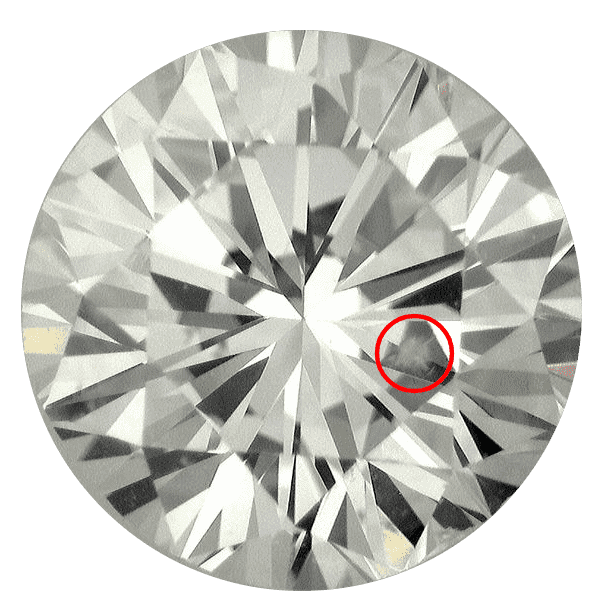
Round diamond showing a bruise inclusion that is circled in red

When it comes to diamond inclusions, a ‘bruise’ is a fairly easy one to understand. Simply put a bruise is a teeny tiny area of impact on the stone. These bruises can happen if diamond rings are mishandled while being stored together, such as inside your jewelry box at home.

The result of this diamond bashing (not to be confused with peeps who talk smack about diamonds) can look very similar to a windshield that’s had an impact from a rock. See how the point of impact stretches out with these fractures or splinters of cracks? That’s what a bruise looks like on a diamond. I admit that this looks sort of extreme, BUT FEAR NOT! The vast majority of them are absolutely tiny.

Bruises are not the most common of inclusions, but you do want to have a good look at that grading certificate in order to ascertain if there are any on your potential forever stone.

Diamond bruise shown on GIA certificate

Diamond bruise as represented by GIA

If the clarity grade is VS1 or above, but the grading report states that the diamond has a bruise, you need not worry about it - it will be impossible to spot and won’t have any major impact on the integrity of the stone either.

If the diamond in question is on the lower end of the clarity grade spectrum then be sure to ask if it can be hidden by the ring setting or if it is likely to turn into a bigger fracture in the future.

Bruise Diamond Inclusion FAQs

What is a “bruise” inclusion on a diamond and how does it happen?

A bruise in a diamond is a small impact mark—almost like a tiny chip or fracture caused by the stone being struck or handled roughly (for example, stored with other stones). The article describes it as looking like the crack that appears on a windshield after a rock hits it.

If a diamond’s certificate mentions a bruise, is it automatically a bad buy?

Not necessarily. The article explains that if the clarity grade is VS1 or higher and the bruise is noted, it’s often so minor that it’s practically invisible and doesn’t affect the diamond’s structural integrity. In that case you needn’t be overly worried. However, if the clarity grade is lower and the bruise is more significant or near the surface, then you should ask how easily it could become a larger fracture or be visible once the diamond is set.

What should a buyer check when considering a diamond with a bruise?

The article advises inspecting the grading report carefully to see where the bruise is located and how it is described. Ask to see clear images or videos of the stone—especially around the area noted—and consider whether it will be covered by the setting or show up face-up. Also check whether the bruise is surface-open or internal, and how thick or deep it is. All this helps assess whether the bruise is benign or deserves a discount.

How much does a bruise affect the diamond’s value or durability?

If the bruise is very minor and the stone is otherwise strong (e.g., good clarity and cut), the impact on value and durability might be negligible—especially if it won’t be visible once set. The article states that in those cases the bruise won’t “have any major impact on the integrity of the stone.” Nevertheless, for larger or more exposed bruises, you’ll want to factor it into your budget or negotiate a lower price, because it can become a problem over time.
Dr. Rian Mulcahy
Dr. Rian Mulcahy
Rian is officially a Diamond PhD - just ping us if you’d like to read her fascinating 200-page thesis, titled Facets of Value: An Investigation into the Formation of Worth in the Diamond Market. She has consulted various firms all along the pipeline, from the rough diamond market to the recycled diamond industry. She holds an MA in Globalisation and Development from University College Cork and a PhD in the Sociology of Diamond Valuation from the London School of Economics.